
Union Fliers Calling for Anti-Chinese & Anti-Japanese Boycotts, 1898
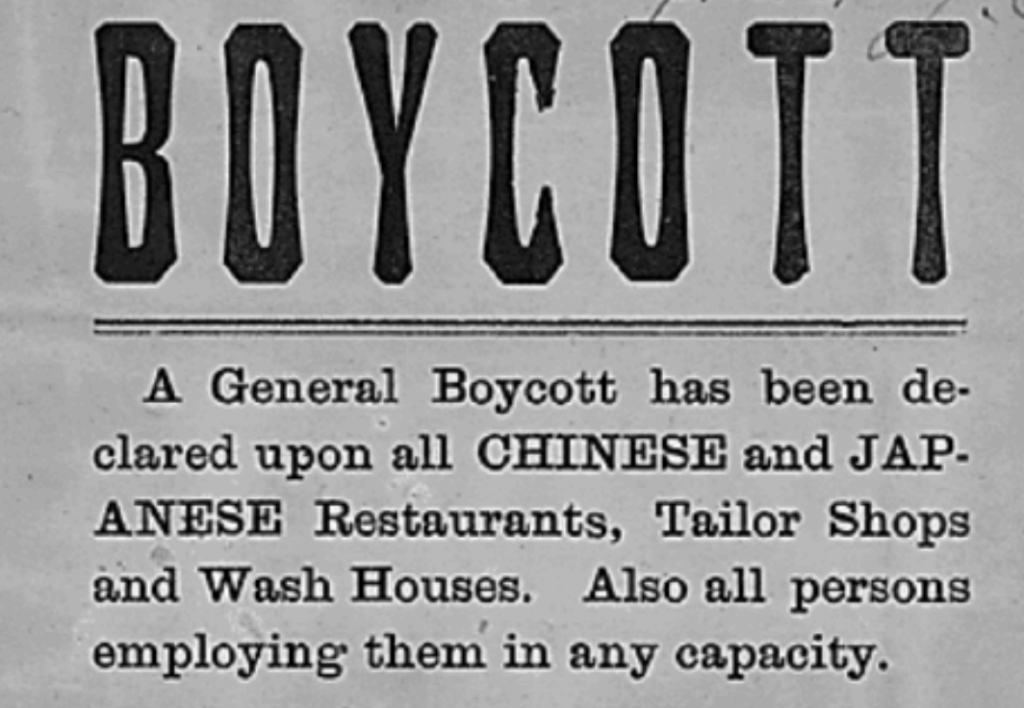
The Chinese Exclusion Act of 1882 was the first federal law to ban immigration based on nationality and race. But legal exclusion didn’t end anti-Asian hostility—in many ways, it legitimized and intensified it.
These fliers, distributed by the Silver Bow Trades and Labor Assembly and Butte Miners’ Union in Montana in the late 1890s, reveal how organized labor often framed Asian workers and business owners as economic and moral threats. The language is stark: “America vs. Asia / Progress vs. Retrogression.”
Several things are worth noticing:
Who issued these fliers? Trade unions—organizations fighting for workers’ rights—used racial exclusion as a organizing strategy. This complicates simple narratives about labor movements as forces for justice. Whose interests were unions protecting? Whose were they attacking?
What arguments do the fliers make? The boycott isn’t framed as mere economic competition. It invokes “standards of living and of morals,” suggesting Asian presence threatens American civilization itself. This linking of race, economics, and morality was central to exclusion-era rhetoric.
Who is targeted? Both Chinese and Japanese communities—the flier makes no distinction. By the 1890s, as Chinese immigration had been legally blocked, Japanese immigrants became the new target of nativist anxiety, a pattern that would continue through the “Gentlemen’s Agreement” of 1907 and Japanese internment during World War II.
Where is this happening? Butte, Montana was a copper mining boomtown with a heavily immigrant workforce—Irish, Cornish, Finnish, Italian, and others. The fliers reveal how some immigrant groups secured their “whiteness” and American belonging by distinguishing themselves from Asian workers.
Teaching Ideas
Source Analysis Have students examine the flier using a primary source analysis framework:
What do you notice first?
What words or phrases stand out?
Who made this? When? Where?
What was happening at this time that might have shaped this document?
What questions does this raise?
Who created this document? For what purpose? Who was the intended audience?
What arguments does the flier use to justify the boycott? Which appeal to economics? Which appeal to something else?
The flier claims to represent “Organized Labor.” What does this tell us about who was included in—and excluded from—the labor movement?
What does the phrase “America vs. Asia” assume about who counts as American?
How might a Chinese or Japanese business owner in Butte have responded to this flier?
Connecting Past and Present The flier’s rhetoric—framing immigrants as threats to wages, living standards, and national identity—echoes across time. Without drawing false equivalencies, students might consider:
Where do we hear similar arguments today?
What’s different about how these arguments are made now?
Who benefits when workers are divided along racial lines?
Complicated Heroes Labor unions fought for the eight-hour day, workplace safety, and fair wages. They also, as this flier shows, sometimes organized around racial exclusion.
Use this document to explore:
Can a movement be both progressive and exclusionary?
How do we hold complexity when studying history?
Whose stories get left out when we simplify the past?
Race and Immigration Historian David Roediger and others have explored how European immigrants in America gained social standing by distinguishing themselves from Black and Asian workers. This flier offers a concrete example. Students might research:
Who were the union members in Butte? Where had they immigrated from?
How did excluding Asian workers help these immigrants claim American identity?
Silences in the Archive We have the flier. We don’t have letters from the Chinese laundry owner who lost customers, or the Japanese restaurant worker who saw this posted. Students might:
Write a response from someone targeted by the boycott
Research what Chinese and Japanese communities in Montana were like in this period
Consider what sources might help us hear those silenced voices
Connections to Other Resources
This document pairs well with:
The Chinese Exclusion Act (1882) and related legislation
Resources on Angel Island and Asian American immigration history
Tyrus Wong’s story and the long shadow of exclusion
Labor history resources that center multiracial solidarity as an alternative path