
Constitutional Protections and Immigration Status
The question of who is protected by the United States Constitution has been debated throughout our nation’s history. Recent debates about immigration have brought this question to the forefront of public discourse. Some supporters of the current administration have argued that due process and constitutional protections do not fully apply to individuals in the United States without citizenship or legal immigration status. Others argue that the Constitution’s protections extend to all persons within U.S. borders, regardless of their immigration status.

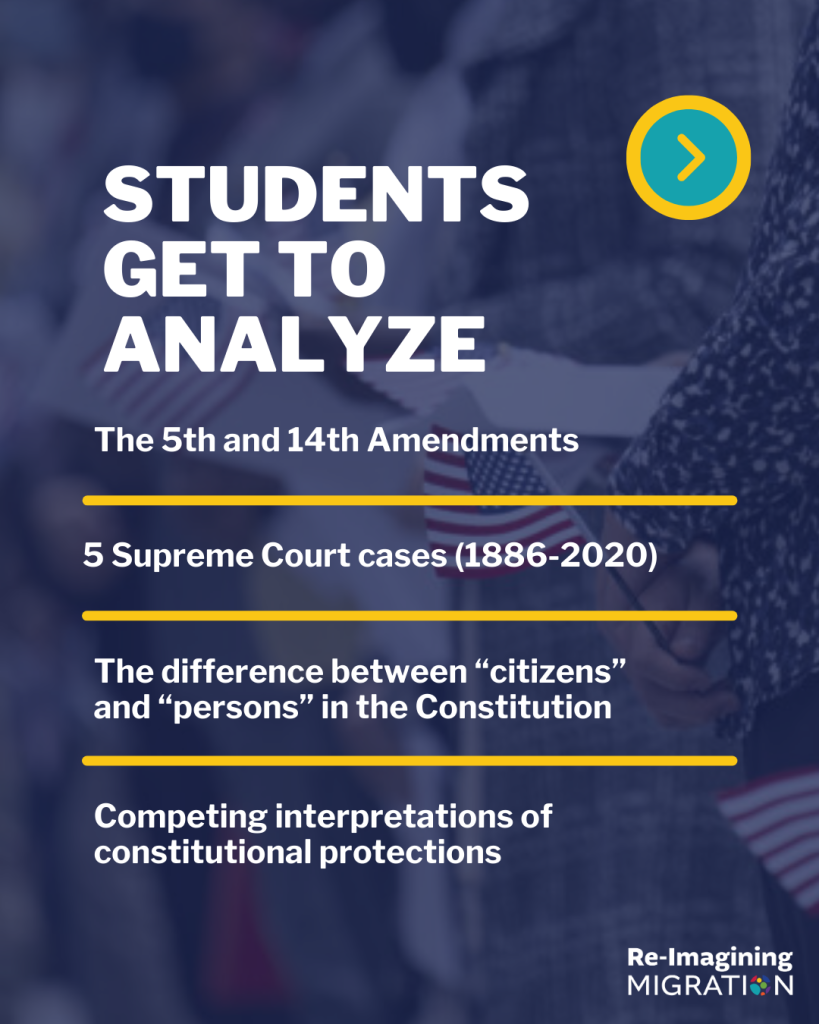

This lesson does not advocate for any particular political position. Instead, it presents key Supreme Court cases, constitutional principles, and competing perspectives to help students develop their own informed understanding of this complex issue.
By examining historical and contemporary legal precedents, students will explore a fundamental question in American civic life: To what extent are constitutional protections guaranteed to all people within the United States?
Access the lesson here as a google document. The full lesson text is below
Lesson Objectives
By the end of this lesson, students will be able to:
- Analyze key Supreme Court cases related to immigration and constitutional rights
- Differentiate between rights guaranteed to “citizens” versus “persons” in the Constitution
- Evaluate competing interpretations of constitutional protections
- Apply historical and legal perspectives to contemporary immigration debates
Guiding Questions
How have Supreme Court battles over non-citizens’ rights shaped our civic understanding of ‘We the People’ and the true reach of constitutional protections?
- Who is protected by the constitution?
- How have Supreme Court rulings shaped our understanding of constitutional protections for non-citizens?
- Is there a difference between national sovereignty and universal rights?
Part 1: Constitutional Framework (20 minutes)
Opening Discussion (10 minutes)
Begin with a close reading of key constitutional provisions:
14th Amendment, Section 1:
“No State shall make or enforce any law which shall abridge the privileges or immunities of citizens of the United States; nor shall any State deprive any person of life, liberty, or property, without due process of law; nor deny to any person within its jurisdiction the equal protection of the laws.”
5th Amendment (excerpt):
“No person shall… be deprived of life, liberty, or property, without due process of law…”
Discussion Questions:
- What specific language is used in these amendments about who is protected?
- What is the difference between “citizens” and “persons” as used in the Constitution?
- Based solely on the text, do these protections appear to include non-citizens?
Key Concepts and Vocabulary (10 minutes)
- Abridge: To cut down or reduce a right. When the government “abridges” your rights, it means they’re making your rights smaller or taking part of them away..
- Deprive: To take something away from someone. In the Constitution, this means the government can’t take away your life, freedom, or things you own without following fair rules first.
- Due Process: Fair treatment through the normal judicial system of courts. Simply, it means the right to have your case heard by a court.
- Equal Protection: The principle that laws must treat all people equally
- Immunities: Special protections that keep you safe from certain rules or actions. Think of these like shields that protect citizens from certain government actions
- Jurisdiction: The official power to make legal decisions and judgments
Have students work in pairs to create a chart comparing constitutional rights explicitly limited to citizens versus rights that apply to “persons.” Based on what they know, what they think they know, and what they want to know.
Part 2: Supreme Court Case Jigsaw (45 minutes)
Expert Group Case Analysis (20 minutes)
Divide the class into five “expert groups,” each assigned to one Supreme Court case:
- Group 1: Yick Wo v. Hopkins (1886)
- Group 2: Plyler v. Doe (1982)
- Group 3: Immigration and Naturalization Service v. Lopez-Mendoza (1984)
- Group 4: Zadvydas v. Davis (2001)
- Group 5: Department of Homeland Security v. Thuraissigiam (2020)
Each expert group studies their assigned case summary and primary source excerpt. :
Teacher’s Notes:
Below are descriptions of the cases. Use this link to access handouts with deceptions of the cases, an excerpt from the ruling, and note about the significance of the cases.
Group 1: Yick Wo v. Hopkins (1886)
Case Summary: This case involved a San Francisco ordinance that required laundries in wooden buildings to have a permit. Of approximately 320 laundries at the time, about 240 were owned by Chinese persons. When permits were required, virtually all non-Chinese applicants received permits, while all Chinese applicants were denied. The Supreme Court ruled unanimously that the 14th Amendment’s equal protection clause applied to all “persons” within U.S. jurisdiction, not just citizens. This distinction matters because if the Constitution only protected “citizens,” the government could discriminate against non-citizens without breaking the law. By ruling that the 14th Amendment protects all “persons,” the ruling has been interpreted to mean that basic rights like equal protection and due process extend to everyone in America, regardless of their citizenship status.
Group 2: Plyler v. Doe (1982)
Case Summary: Texas enacted a law withholding state funds from local school districts for educating children who were not “legally admitted” to the United States and authorizing districts to deny enrollment or charge tuition to these children. The Supreme Court ruled 5-4 that undocumented children have a constitutional right to receive a public education. The Court determined that denying education would create a “lifetime of hardship” and a “permanent underclass.”
Group 3: Immigration and Naturalization Service v. Lopez-Mendoza (1984)
Case Summary Two individuals, Adan Lopez-Mendoza and Enrique Sandoval-Sanchez, were ordered deported after separate INS investigations. In both cases, the individuals argued that their arrests violated the Fourth Amendment because INS agents lacked reasonable suspicion or probable cause. They sought to suppress evidence of their illegal status obtained during these arrests, arguing that it should not be admissible in their deportation hearings.
The Supreme Court, in a 5-4 decision, held that the exclusionary rule does not apply in deportation proceedings. The Court reasoned that the social costs of applying the rule in this context would be too high, given the distinct nature of deportation proceedings and the government’s interest in enforcing immigration laws. The Court emphasized that deportation is a civil, not a criminal, matter and that the exclusionary rule is primarily designed to deter police misconduct in criminal cases.
The Court did not rule that Lopez-Mendoza and Sandoval-Sanchez lacked Fourth Amendment protections — in theory, they were “persons” entitled to be free from unreasonable searches and seizures. But because violations of those rights carry no consequence in deportation proceedings, the protection cannot be enforced there.
Group 4: Zadvydas v. Davis (2001)
Case Summary: This case involved immigrants who had been ordered deported, but no country would accept them. The petitioners in the case, Kestutis Zadvydas and Kim Ho Ma, were being held in immigration facilities in the US, Kestutis Zadvydas was detained in Louisiana, and Kim Ho Ma was detained in Washington state. The government claimed it could detain them indefinitely. The Supreme Court ruled 5-4 that indefinite detention of immigrants, even those ordered deported, raised serious constitutional concerns and was not authorized by immigration statutes. The Court interpreted the law to include a “reasonable time” limitation of six months.
Group 5: Department of Homeland Security v. Thuraissigiam (2020)
Case Summary: This case involved an asylum seeker who sought to challenge his expedited removal (a fast-track deportation process that bypasses regular immigration court hearings) through habeas corpus proceedings (a legal action that allows detained individuals to request a court to determine if their detention is lawful) after crossing the southern border. The Supreme Court ruled 7-2 that certain asylum seekers subject to expedited removal procedures do not have a constitutional right to habeas corpus review beyond what Congress has provided by statute. The Court distinguished between those with established connections to the U.S. and recent arrivals.
During this time, expert groups should:
- Carefully read their case summary and primary source excerpt
- Identify what issues are at stake and consider how they relate to the constitution.
- Discuss how the Court defines who is a “person” entitled to constitutional protections
- Prepare to explain their case to peers in 2-3 minutes
Jigsaw Teaching (15 minutes)
Reorganize students into mixed groups with at least one expert from each case. In these jigsaw groups, students take turns teaching their cases to peers while others complete their graphic organizers.
Cross-Case Analysis (10 minutes)
After all presentations, jigsaw groups discuss:
- How has the Court’s interpretation of who is a “person” under the Constitution evolved?
- What tensions exist between national sovereignty and universal rights?
- How do these cases connect to our understanding of “We the People”?
Part 3: Fishbowl Discussion (15 minutes)
Setting Up the Fishbowl (2 minutes)
Arrange chairs in two concentric circles:
- Inner circle: 5 chairs for active discussants
- Outer circle: Remaining chairs for observers
Explain that students in the inner circle will engage in discussion while those in the outer circle observe. Students can rotate in and out of the inner circle by tapping someone’s shoulder to replace them.
Fishbowl Discussion Guidelines (15 minutes)
Share the following guidelines:
- Listen actively and respectfully to others
- Speak one at a time
- Support claims with evidence from the cases studied
- Connect comments to our essential question
- Outer circle students should take notes on key points raised
Share this frame for the discussion:
“The opening phrase in the U.S. Constitution is ‘We the People.’ What do you think this phrase means? The Supreme Court (our country’s highest court) has made decisions about whether non-citizens have rights under our Constitution. How have these court decisions defined who counts as part of ‘We the People’ and who the Constitution protects?”
Suggested prompts to keep discussion moving:
- How do these court decisions reflect America’s evolving civic identity?
- What connections do you see between these cases and contemporary debates?
- What do these cases suggest about the relationship between legal status and constitutional protections?
Conclusion and Assessment (5 minutes)
Project Zero’s Three Whys Reflection
Students individually complete a written reflection addressing Project Zero’s Three Whys:
- Why do these cases matter to me?
- Why do these cases matter to my community?
- Why do these cases matter to the country and the world?
Extension Activities and Resources
Scenario Analysis
Present students with the following scenarios. In their teaching groups, students should apply the constitutional principles and case precedents they’ve learned to analyze each situation:
- Scenario 1: Border Detention A family seeking asylum is detained at the border. They have been held for three months without a hearing. They file a petition claiming their due process rights are being violated.
- Scenario 2: Public Education A state passes a law requiring schools to verify the immigration status of all students and report undocumented students to immigration authorities.
- Scenario 3: Criminal Proceedings A long-term undocumented resident is arrested and not informed of his right to an attorney. Evidence obtained during questioning is used in his criminal trial.
- Scenario 4: Indefinite Detention An immigrant with a deportation order has been detained for two years because his home country refuses to accept him back. He files a petition challenging his continued detention.
For each scenario, students should determine what constitutional protections might apply
Constitutional Perspectives Extension
For a deeper exploration of different interpretations of constitutional protections, consider having students analyze these three perspectives in a follow-up lesson:
- Perspective 1: Territorial Approach to Constitutional Rights This view holds that constitutional protections apply to all persons physically present within U.S. territory regardless of immigration status.
- Perspective 2: Connections and Context Approach This perspective suggests that while basic protections apply to everyone physically present, the extent of constitutional rights may vary based on an individual’s connections to the U.S.
- Perspective 3: Governmental Powers Approach This view emphasizes the constitutional allocation of power between branches of government in immigration matters.
Additional Extension Options
Research a current immigration-related Supreme Court case
- Compare constitutional protections for non-citizens across different democratic countries
- Analyze news coverage of immigration cases for different perspectives
- Interview local immigration attorneys about their experiences with constitutional issues
Connections to the Learning Arc
The lesson “Constitutional Protections and Immigration Status” helps explore several key questions from the Re-Imagining Migration Learning Arc, specifically from the “Understanding Migration” section. Here are the relevant questions it addresses:
- What are the rights of people on the move? This question is central to the lesson as it examines constitutional protections for non-citizens, exploring how legal frameworks apply to individuals regardless of their immigration status.
- How do individuals and societies navigate their relationships to people on the move? By analyzing Supreme Court cases, students learn how U.S. legal systems have historically navigated the rights of immigrants, reflecting broader societal attitudes and policies.
- How do local cases of migration relate to global patterns? The lesson encourages students to consider how U.S. constitutional interpretations of non-citizens’ rights compare to global norms and practices, prompting reflection on universal rights versus national sovereignty.
- What can we learn from other narratives about migration to help inform our perspective? By examining historical and contemporary legal precedents, students gain a deeper understanding of migration narratives and their impact on civic life.
By addressing these questions, the lesson fosters critical inquiry and helps students connect legal frameworks to broader migration themes.
Additional Resources
U.S. Constitution and amendments (full text)
“Are Foreign Nationals Entitled to the Same Constitutional Rights As Citizens?” Georgetown Law Journal